Thursday, June 20, 2019

Nimrod a “mighty man”


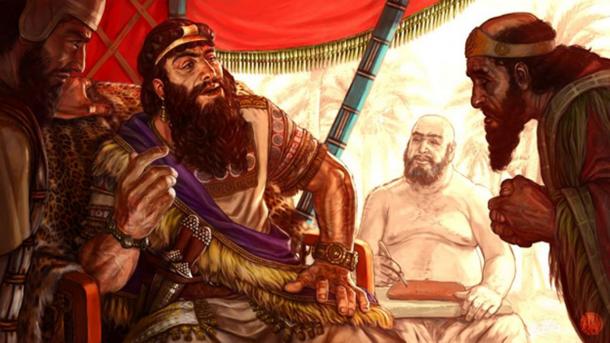
Image result for mesopotamian king
 
by
 
Damien F. Mackey


“After surveying previous attempts to identify an “historical” Nimrod, the author then suggests that the biblical figure is modeled after the combined traditions 
about Sargon of Akkad and his grandson, Naram-Sin”.
 
Dr. Yigal Levin


Part One:
Hunting him amongst the Akkadians
 
 
Yigal Levin, when referring to “… “The Table of Nations” recorded in Genesis x”, has described as “arguably the most fascinating passage  in the Table – the Nimrod story recounted in verses 8-12” (Nimrod the Mighty, King of Kish, King of Sumer and Akkad“Nimrod the Mighty, King of Kish, King of Sumer and Akkad”, VT, Vol. 52, Fasc. 3, July 2002, p. 350). Vol. 52, Fasc. 3 (Jul., 2002),
Vol. 52, Fasc. 3 (Jul., 2002), pp. 350-366 (17 pages)
 
 
Reasonable historical candidates who have been proposed for the imposing character of biblical Nimrod are Enmerkar (Uruk, c. 4500 BC); Gilgamesh (Early Dynastic, Uruk, c. 2900 BC); Sargon of Akkad (c. 2330 BC) and Naram-Sin of Akkad (c. 2250 BC).
 
Enmerkar (Enmer “the hunter”) was David Rohl’s choice; whilst Dr. David Livingston favours the semi-legendary Gilgamesh for Nimrod.
Despite the one and a half millennia time gap between these two kings by conventional reckoning (which is mostly wrong), the fact that Enmerkar was, Gilgamesh was, a mighty man of renown, a hunter, and, more specifically, a builder of the walls of Uruk (in Enmerkar’s case, ‘a wall to protect Uruk’), it may be worthwhile (at some later stage) to test whether we are dealing here with just the one mighty king – and, possibly, with Nimrod himself.
 
David Rohl has also linked the famous Narmer, perhaps of non-Egyptian origins, with Nimrod – a connection I, too, would seriously consider being a possibility. 
 
Sargon of Akkad is Dr. Douglas Petrovich’s (amongst others) choice for Nimrod; whilst, regarding Naram-Sin, Dr. Yigal Levin has - as I, too, have recently favoured in:
 
Assyrian King Sargon II, otherwise known as Sennacherib. Part Three: Akkadian King Sargon I, otherwise known as Naram-Sin?
 
https://www.academia.edu/39616195/Assyrian_King_Sargon_II_otherwise_known_as_Sennacherib._Part_Three_Akkadian_King_Sargon_I_otherwise_known_as_Naram-Sin
 
 - identified Nimrod with a combined Sargon/Naram-Sin, though, in Levin’s case (not in mine), Sargon and Naram-Sin remain separate historical entities. Thus he has written:
 
After surveying previous attempts to identify an “historical” Nimrod, the author then suggests that the biblical figure is modeled after the combined traditions about Sargon of Akkad and his grandson, Naram-Sin. Nimrod is the son of “Cush”; Sargon began his royal career at Kish right after the flood. The Sargon-Naram-Sin traditions reached the Levant during the second millennium BCE, being combined by time and distance into a composite personality.
[End of quote]
 
Or, perhaps “time and distance” have caused to be split in twain he who was originally just the one Akkadian potentate.
 
From a combination of data such as Dr. John Osgood’s archaeology for Abram (Abraham); the tradition of Abram’s having been a contemporary of Menes of Egypt; Dr. W. F. Albright’s argument for this same Menes having been conquered by Naram-Sin of Akkad; Narmer (possibly = Naram-Sin) being archaeologically attested in Palestine at this time; Albright’s and Anne Habermehl’s location of Akkad (in Shinar) in NE Syria; biblical Amraphel of Shinar a contemporary of Abram’s; and the tradition of Nimrod’s having accompanied Chedorlaomer of Elam against Syro-Palestine at the time of Abram, then I can ultimately arrive at only this one conclusion:
 
Sargon of Akkad (in Shinar) = Naram-Sin (= Nimrod) must be
the biblical “Amraphel … king of Shinar” (Genesis 14:1).
 
The name “Amraphel” may, or may not, be a Hebrew name equating to a Shinarian one.
Abarim Publications appears to have trouble nailing it:
http://www.abarim-publications.com/Meaning/Amraphel.html#.XQmBvuQ8R9A
Meaning
Unclear, but perhaps: One That Darkens Counsel, or The Commandment Which Went Forth
Etymology
Unclear, but perhaps from (1) the verb אמר (amar), to talk or command, and (2) the verb אפל ('pl), to be dark.
 
Before concluding: “The name Amraphel can mean One That Darkens Counsel, or in the words of Alfred Jones (Dictionary of Old Testament Proper Names): One That Speaks Of Dark Things”.
 
 
There may be needed at least one further Akkadian addition to my equation: Sargon of Akkad = Naram-Sin = Nimrod, and that relates to my earlier hint of an identification between:
 
Sargon and Shar-Kali-Sharri
 
https://www.academia.edu/39473281/Sargon_and_Shar-Kali-Sharri
 
given the same apparent meaning of these two names, but more especially that the name “Sargon” (Shar-Gani) is actually included in a presumed version of the name, Shar-kali-sharri.
 
E.g. compare this: https://dinromerohistory.wordpress.com/tag/sargon
“Sargon of Akkad (also known as Sargon the Great, Shar-Gani-Sharri, and Sarru-Kan, meaning “True King” or “Legitimate King”) …”.
 
with this: https://nl.qwerty.wiki/wiki/Shar-Kali-Sharri
“Shar-Kali- Sharri (shar-Gani-Sharri ; rc 2217-2193 BC …”.


Part Two:
Hunting him amongst the Sumerians
 
 
The biblical Nimrod has, at least as it seems to me, multi historical personae, just as I have found to have been the case with the much later (Chaldean) king, Nebuchednezzar.
The historical Nebuchednezzar - as he is currently portrayed to us - needs his other ‘face’, Nabonidus of Babylon, for example, to complete him as the biblical “King Nebuchadnezzar” (or “Nebuchadrezzar”); Nabonidus being mad, superstitious, given to dreams and omens, statue-worshipping, praising the god of gods (ilani sa ilani); having a son called “Belshazzar”.
The biblico-historical Nebuchednezzar also needs Ashurbanipal to fill out in detail his 43 years of reign, to smash utterly the nation of Egypt – Ashurbanipal also having a fiery furnace in which he burned people.
But Nebuchednezzar also needs Esarhaddon (conquering Egypt again) whose mysterious and long-lasting illness is so perfectly reminiscent of that of Nebuchednezzar in the Book of Daniel; Esarhaddon especially being renowned for his having built Babylon.
Nebuchednezzar has other ‘faces’ as well, he being Nabopolassar, the careful archaeologist (like Nabonidus), fussing over the proper alignment of temples and other buildings, and as the so-called Persian king, Cambyses, also named “Nebuchednezzar”, again quite mad, and being a known conqueror of Egypt. And we need to dip into Persia again, actually the city of Susa, to find Nebuchednezzar now in the Book of Nehemiah as the “Artaxerxes king of Babylon” reigning in his 20th to 32nd years (cf. Nehemiah 2:1 and 13:6).
Extending matters yet still further, our necessary revisionist folding of ‘Neo’ Babylonia with ‘Middle Kingdom’ Babylonia has likely yielded us the powerful (so-called) Middle Babylonian king Nebuchednezzar I as being another ‘face’ of the ‘Neo’ Babylonian king whom we number as Nebuchednezzar II.
 
In similar fashion, apparently, has our conventional biblico-history sliced and diced into various pieces, Nimrod the mighty hunter king.
I have already ventured to re-attach Nimrod to his Akkadian personae as (i) Sargon of Akkad; (ii) the deified Naram-Sin; and (iii) Shar-kali-sharri.
And to the biblical “Amraphel … king of Shinar” (Genesis 14:1).
Other possibilities being Narmer, and those semi-legendary names, Enmerkar and Gilgamesh.
 
Now here, in Part Two, I shall be looking to test whether Nimrod can ‘boast’ of having further identification amongst one, or more, of those mighty Sumerian kings of the dynasty of Ur III, who claimed to have ruled both “Sumer and Akkad”. 
 
In my recent article:
 
Assyrian King Sargon II, otherwise known as Sennacherib. Part Three: Akkadian King Sargon I, otherwise known as Naram-Sin?
 
https://www.academia.edu/39616195/Assyrian_King_Sargon_II_otherwise_known_as_Sennacherib._Part_Three_Akkadian_King_Sargon_I_otherwise_known_as_Naram-Sin
 
I wrote, regarding my thesis identification of Sargon II with Sennacherib:
 
“Other factors seemingly in favour of the standard view that Sargon II and Sennacherib were two distinct kings may be, I suggest, put down to being ‘two sides of the same coin’.” And I went on to liken that situation to Sargon of Akkad and Naram-Sin, two sides of the same coin.
Now here, when considering the so-called Ur III dynasty in relation to the Akkadian dynasty, but also, when considering Ur III’s Ur-Nammu in relation to Shulgi, I think that the “coin” maxim may continue to apply.
 
Taking, firstly, the supposedly two dynasties, we find that the Akkadian one, very rich in legend, is quite poor in documentation. But might that surprising lack be supplied by the super-abundant documentation to be found with Ur III, as M. Van de Mieroop tells (A History of the Ancient Near East ca. 3000 – 323 BC, p. 72):
 
Virtually no period of ancient Near Eastern history presents the historian with such an abundance and variety of documentation [as does Ur III]. Indeed, even in all of the ancient histories of Greece and Rome, there are few periods where a similar profusion of textual material is found.
[End of quote]
 
On the other hand, whilst the Akkadian kings were greatly celebrated down through the centuries (ibid., p. 68): “There was no doubt in the public imagination that Sargon and Naram-Sin had been the greatest kings who ever ruled. They became the paradigms of powerful rulers and were the subjects of numerous detailed stories, created and preserved for almost two millennia”, this was by no means the case with the Ur III names (ibid., p. 72): “Remarkable is the lack of interest in this period by later Mesopotamians when compared to how the Akkadian kings were remembered. …. In later centuries, only a handful of references to the Ur III kings are found”.
 
And this, despite the massive volume of Ur III documentation!
 
On p. 73, Van de Mieroop will make a further distinction between Akkadian and Ur III: “The Ur III state was indeed of a different character than its predecessor: geographically more restricted in size, but internally more centrally organized”.
 
However, the full extent of the geography of Akkadian, of Ur III, has not been properly grasped, I would suggest, with Akkadian being incorrectly centred in Sumer, and Ur III ruling, not only Sumer, but Akkad as well. (Van de Mieroop, p. 71): “Ur-Namma … he could claim … a new title, “King of Sumer and Akkad”.”
 
Despite the apparent differences, there are also plenty of similarities.
(Van de Mieroop, p. 60): “A new system of taxation was developed …. In the reign of Naram-Sin, a standardization of accounting is visible in certain levels of administration in order to facilitate central control”. [Recall Ur III: “… internally more centrally organized”].
(P. 73): “The central administration [Recall Akkadian: “… administration in order to facilitate central control”] established a system of taxation that collected a substantial part of the provinces’ resources”. 
 
Also Akkadian, Ur III, military and trade expansions were widespread.
(Van de Mieroop, p. 60): “[Sargon] claimed that he captured “fifty governors and the city of Uruk”.” P. 63: “The Akkadian kings focused their military attention on the regions of western Iran and northern Syria … east … Elam, Parahshum and Simurrum. In the north … Tuttul … Mari and Ebla”.
(P. 74): “In the Persian Gulf, Ur maintained the trade contacts that had existed since [sic] the Old Akkadian period. P. 76: “In the Ur III sources … we find references to people from the Syrian cities of Tuttul, Ebla and Urushu …”.
 
(Van de Mieroop, p. 63): “Ships from overseas areas, such as Dilmun … Magan … Meluhha … are said to have moored in Akkad’s harbor …”.
 (p. 76): “Already Ur-Namma claimed to have restored trade with Magan …”.
 
(Van de Mieroop, p. 61): “[Akkadian] introduction of an annual dating system …”.
(p. 74): “… Shulgi may have attempted to introduce a standard calendar throughout the land”.
 
(Van de Mieroop, p. 64): “[Naram-Sin] After crushing a major rebellion … took the unprecedented step … of making himself a god”.
(P. 76): “Before his twentieth year of rule Shulgi was deified”.
 
(Van de Mieroop, p. 64): “[An Inscription in Iraq refers to] “Naram-Sin, the strong one …”.
(Brit. Museum cylinder seal, no: 89131): “Shulgi, the strong man … [shul-gi nita kala-ga]”.
https://www.britishmuseum.org/research/collection_online/collection_object_details.aspx?objectId=368840&partId=1
This description of Naram-Sin, of Shulgi, could easily remind one of the biblical Nimrod (גִּבֹּ֖ר), gibbor, “a mighty one”, “a strong one” (Genesis 10:8).
  
Now, as in the case of the Akkadians with Sargon, and deified Naram-Sin, and Shar-kali-sharri, at least, all having been merged into the one king - different sides of the same coin, as I said - so may it possibly be with the Ur III dynasty, Ur-Nammu, and deified Shulgi, and Amar-Sin, to be merged together, but also, now to be interlaced with the Akkadians.
 
In other words, our composite biblical Nimrod-Amraphel now to become, all at once:
 
Sargon = Naram-Sin = Shar-kali-sharri = Ur-Nammu = Shulgi = Amar-Sin
 
 
Already mentioned has been “Remarkable … [the] lack of interest in this period [Ur III] by later Mesopotamians …”.
And I have read somewhere that later generations tended to focus their attention (when they did actually refer back to the Ur III kingship) upon Shulgi to the exclusion of the other names. 
There is perhaps no ancient king who so resembles the Nimrod of the Bible and traditions in his strength and heroic deeds as does the long-reigning Shulgi. To give just this one description:
http://www.ancientpages.com/2019/03/22/divine-shulgi-of-ur-influential-long-ruling-king-conqueror-and-native-akkadian-speaker-in-five-languages/

….

Shulgi Boasted Much About His Abilities And With Good Reason

 
As the most influential ruler of Ur III king, Shulgi was native Akkadian speaker who was fluent in five languages like Elamite, Sumerian, Hurrian, Amorite and even Meluhhan (Dravidian). He was trained as a scribe and organized schools for scribes. He was a self-confident ruler who declared himself a divinity and established a tradition of royal praise for himself in many hymns.
 
....
“Shulgi boasts that he hunts lions and serpents in steppe…. without the aid of a net or enclosure… He claims to be so fast on his feet he can catch a gazelle on the run..” (Kramer N. S.)
….
Usually people wrote hymns for the gods, but Shulgi wrote a hymn to honor himself.
In “The Sumerian World,” Harriet Crawford writes that “by some accounts, in 2088 BC, during what is known as the King’s Run, documents show that Shulgi claimed that during a celebration of eshesh, he ran the distance of the parade (200 miles round-trip) from Nippur to Ur and back.
“That my name be established until distant days and that it leave not the mouth of men, that my praise be spread  wide in the land; I, the runner  rose in my strength… and from Nippur to Ur I resolved to travel…”
"My black-headed people marveled at me" he wrote.
The problem is that Nippur was at the distance of 100 miles from Ur. Shulgi claimed that he run 100 miles and then he run back home again. All that happened in one day and during a storm. Did Shulgi really run 200 miles in the stormy weather or was it only a way to glorify himself? ….
[End of quote]
 
Works begun by Ur-Nammu, such as the great ziggurat of Ur (a replica of the Tower of Babel?), are thought to have been completed by Shulgi.
Ur-Nammu’s Law Code is attributed by some to Shulgi instead.
Two sides of the same coin?
 
And, just to include briefly (and to conclude with) Amar-Sin, I have previously written:
 
….
Normally one will find that, prior to, say, the C8th BC approximately, the conventional history is well out of kilter with the biblical history. In the case of the Ur III dynasty, however, which some consider to be contemporaneous with Abraham, the unusual situation may actually be that these two histories are in fact closely synchronous. Revisionist scholar, David Rohl – presumably following Herb Storck (see below) – has accepted this syncretism between the two and has proceeded to identify Abraham’s contemporary, Amraphel of Shinar, with Ur III’s Amar-Sin (c. 1980 BC, conventional dating).
Despite the likes of Kenneth Kitchen arguing that the Genesis 14 coalition of kings would have to have occurred at a time in Mesopotamian history when, in the words of McClellan “no individual dynasty had complete control over the region” (Kitchen wrote on this):
 
However, by contrast with the Levant, this kind of alliance of eastern states was only possible at certain periods. Before the Akkadian Empire, Mesopotamia was divided between the Sumerian city-states, but this is far too early for our narrative (pre-2300). After an interval of Gutian interference, Mesopotamia was then dominated by the Third Dynasty of Ur, whose influence reached in some form as far west as north Syria and Byblos. After its fall, circa 2000, Mesopotamia was divided between a series of kingdoms, Isin, Larsa, Eshnunna, Assyria, etc., with Mari and various local powers in lands farther north and west. This situation lasted until the eighteenth century, when Hammurabi of Babylon eliminated most of his rivals. From circa 1600/1500 onward, Assyria and Babylon (now under Kassite rule) dominated Mesopotamia, sharing with none except briefly Mitanni (ca. 1500 to mid-thirteenth century) within the Euphrates’ west bend, and the marginal Khana and Sea-land princedoms were eliminated in due course. Thus, from circa 2000 to 1750 (1650 at the extreme), we have the one and only period during which extensive power alliances were common in Mesopotamia and with its neighbors (Kitchen 2003, p. 320) [,]
 
I think it is quite possible that this coalition could have consisted of two dominant rulers,
Amraphel and Chedorlaomer of Elam, and two of their governors.
 
Did not the neo-Assyrian kings later boast that their ‘governors were all kings’?
 
Thus the two other coalitional kings listed in Genesis 14:1, “Arioch king of Ellasar”, and “Tidal king of Goyim”, were likely of secondary status by comparison with Amraphel and Chedorlaomer, and may thus have been only local rulers, e.g., ensi-governors.
Herb Storck has made some potentially important observations regarding these two characters, Erioch and Tidal, in his article, “The Early Assyrian King List, The Genealogy of the Hammurapi Dynasty, and the ‘Greater Amorite’ Tradition” (C and AH Proceedings 3, 1986).
 
Here I reproduce a summary I made of the relevant parts of this article back in 2002:
 
Storck’s identification of the name 16 [in Assyrian King List: AKL], Ushpia (Ishbak), with the “Ushpia … known to have built at Ashur, according to a later tradition by Shalmaneser”, and his dating of this Ushpia “as a later contemporary of Abraham … [to] the later part of Ur III dynasty” now encourages me to try to identify members of the Mesopotamian coalition of Genesis 14 during Ur III, at the time of Abraham. Since Storck has already dealt with these four kings in part, I shall begin where he does, with Arioch of Ellasar [p. 45. Storck had already noted, with reference to Poebel, that the name Azarah might be composed of a Western Semitic (WS) form, “to come forth” and WHR “moon” (month)]:
A certain Arioch of Ellasar, furthermore, is cited as one of the four kings against five. This Arioch may provisionally be identified with Azarah if “WRH” moon (month) is closer to the original etymology. Ellasar has received various treatments over the years: Larsa al sarri or “city of the King”, Til Assuri, “the country of Assyria” and/or “the city of Assur ….The connection between Ellasar is explained as a derived form of A LA-SAR, an ideogram denoting the city of Assyria” …. That “Assur” is meant here may receive further support if the connection with Arioch-Azarah is defensible. However, to the best of our knowledge A LA SAR is not an attested reading for Assur. We therefore suggest that it was heard as “alu Assur” and “Ellasar” is an attempt to render this, based on oral transmission.
 
Now in the later part of the Ur III dynasty era – the era for Abraham according to Storck’s view – at the time of Amar-Sin of Ur (c. 2046-2038 BC, conventional dating), we read of an official of Ashur who may well be this Arioch/Azarah. He is Zariqum. I quote regarding him from the Cambridge Ancient History [Vol. I, pt. 2 (3rd ed.), p. 602]:
 
“From Ashur itself comes a stone tablet dedicated by Zariqum, calling himself governor of Ashur, ‘for the life of Amar-Sin the mighty, king of Ur, king of the four regions’, whereby it is certain that Ashur was a vassal-city of Ur under its next king”.
 
The name Zariqum contains the main elements of both Arioch (ariq) and Azarah (zari), thus supporting Storck’s view that these are the same names, and further linking the king lists and the Bible. But this quotation may tell us more with regard to the coalition. It in fact gives us the name of the Sumerian ruler whom Zariqum served: Amar-Sin (var. Amar-Su’en).
[End of quotes]
 
I think that there is an excellent possibility that Amar-Sin - with whom in this article I have merged Akkadian as well as other of the Ur III king names - was likewise the biblical Nimrod-Amraphel (in league with Arioch-Zariqum).
 

Monday, June 10, 2019

Epic of Gilgamesh shows Hebrew influences


by


Damien F. Mackey


“There are still other parallels between the Bible and the Gilgamesh epic: "YaHVeH"

has a somewhat similar sound to "Huwawa." Gilgamesh did just as the "sons of god"

in Genesis 6 did. The "sons of god" forcibly took men's wives. The Epic says

that is precisely what Gilgamesh did. The Bible calls Nimrod a tyrant, and Gilgamesh

was a tyrant. There was a Flood in the Bible, there is a flood in the Epic”.


Dr. David Livingston


Ancient pagan literature is, as we have found, replete with allusions – {tales, poetry, wisdom, philosophy, law, epic, etc.} - to the Hebrew scriptures. Most notably, to Genesis (Creation, Flood); Nimrod; Moses; Samson; David and Solomon; Ahab and Jezebel; Job-Tobias; Judith. For instance, see my article:


Hebrew Law absorbed by Mesopotamians, Greeks


Or, again:


On and on it goes. There is also a “Babylonian Job” as we shall read below in 4.


Gilgamesh apparently was a real historical king: https://en.wikipedia.org/wiki/Gilgamesh

“He probably ruled sometime between 2800 and 2500 BC and was posthumously deified”.

But the famous Epic of Gilgamesh is something of a potpourri of episodes, certain of them traceable to the Bible.

For example:


  1. The Flood


“The Epic of Gilgamesh has been of interest to Christians ever since its discovery in the mid-nineteenth century in the ruins of the great library at Nineveh, with its account of a universal flood with significant parallels to the Flood of Noah's day.1, 2 The rest of the Epic, which dates back to possibly third millennium B.C., contains little of value for Christians, since it concerns typical polytheistic myths associated with the pagan peoples of the time. However, some Christians have studied the ideas of creation and the afterlife presented in the Epic. Even secular scholars have recognized the parallels between the Babylonian, Phoenician, and Hebrew accounts, although not all are willing to label the connections as anything more than shared mythology.3”


  1. Nimrod


No need to presume, Dr. D. Livingston straight out believes that:


Gilgamesh is Nimrod


Model of ancient ziggurat.

How does Gilgamesh compare with "Nimrod?" Josephus says of Nimrod,


Now it was Nimrod who excited them to such an affront and contempt of God. He was the grandson of Ham, the son of Noah -- a bold man, and of great strength of hand. He persuaded them not to ascribe it to God, as if it were through his means they were happy, but to believe that it was their own courage which procured that happiness. He also gradually changed the government into tyranny -- seeing no other way of turning men from the fear of God, but to bring them into a constant dependence upon his own power. He also said he would be revenged on God, if he should have a mind to drown the world again; for that he would build a tower too high for the waters to be able to reach! and that he would avenge himself on God for destroying their forefathers (Ant. 1: iv: 2)


What Josephus says here is precisely what is found in the Gilgamesh epics. Gilgamesh set up tyranny, he opposed YHVH and did his utmost to get people to forsake Him.


Two of the premiere commentators on the Bible in Hebrew has this to say about Genesis 10:9,

Nimrod was mighty in hunting, and that in opposition to YHVH; not "before YHVH" in the sense of according to the will and purpose of YHVH, still less, . . . in a simply superlative sense . . . The name itself, "Nimrod" from marad, "we will revolt," points to some violent resistance to God . . . Nimrod as a mighty hunter founded a powerful kingdom; and the founding of this kingdom is shown by the verb with vav consecutive, to have been the consequence or result of his strength in hunting, so that hunting was intimately connected with the establishing of the kingdom. Hence, if the expression "a mighty hunter" relates primarily to hunting in the literal sense, we must add to the literal meaning the figurative signification of a "hunter of men" (a trapper of men by stratagem and force); Nimrod the hunter became a tyrant, a powerful hunter of men (Keil and Delitzsch 1975: 165).


"in the face of YHVH can only mean "in defiance of YHVH," as Josephus and the Targums understand it (op. cit.: 166).


And the proverb must have arisen when other daring and rebellious men followed in Nimrod's footsteps and must have originated with those who saw in such conduct an act of rebellion against the God of salvation, in other words, with the possessors of the divine promise of grace (loc. cit.).


Often attributed to Nimrod, the Tower of Babel (Genesis 11:1-9) was not a Jack and the Beanstalk type of construction, where people were trying to build a structure to get into heaven. Instead, it is best understood as an ancient ziggurat (Assyrian "mountaintop"), as the one pictured here from ancient Ur of the Chaldees, Abraham's hometown (Genesis 11:31). A ziggurat was a man-made structure with a temple at its top, built to worship the host of heaven.

After the Flood there was, at some point, a breakaway from YHVH. Only eight people descended from the Ark. Those people worshipped YHVH. But at some point an influential person became opposed to YHVH and gathered others to his side. I suggest that Nimrod is the one who did it. Cain had done similarly before the Flood, founding a new city and religious system.


Our English translation of the Hebrew of Genesis 10:8-10 is weak. The author of this passage of Scripture will not call Gilgamesh by his name and honor him, but is going to call him by a derisive name, what he really is -- a rebel. Therefore we should translate Genesis 10:8-10 to read,

Cush begat Nimrod; he began to be a tyrant in the earth. He was a tyrannical hunter in opposition to the Lord. Thus it is said, "Nimrod the tyrannical opponent of YHVH."

Likewise, Gilgamesh was a man who took control by his own strength. In Genesis 10 Nimrod is presented as a type of him. Nimrod's descendants were the ones who began building the tower in Babel where the tongues were changed. Gilgamesh is a type of early city founders. (Page numbers below are from Heidel 1963)


He is a "shepherd" .................. page 18
From Uruk ............................. page 17  (Kramer 1959: 31 calls Uruk, Erech.)
A giant ................................... page 17  (11 cubits)
Builds cities ............................ page 17
Vile man "takes women" ......... page 18
Mighty hunter ......................... page 18


Gilgamesh Confronts YHVH!


The name of YHVH rarely appears in extra-Biblical literature in the Ancient Near East. Therefore we would not expect to find it in the Gilgamesh epic. But why should the God of the Jews rarely be mentioned? The Hebrew Bible is replete with the names of other gods.

On the other hand, the nations surely knew of Him even though they had no respect for Him. If so, how might His Name appear in their literature, if at all?

The name of YHVH, in a culture which is in rebellion against His rule, would most likely be in a derisive form, not in its true form. Likewise, the writers of Scripture would deride the rebels.


Putting the Bible and the Gilgamesh Epic Together


The Gilgamesh Epic describes the first "God is Dead" movement. In the Epic, the hero is a vile, filthy, perverted person, yet he is presented as the greatest, strongest, hero that ever lived. (Heidel 1963: 18). So that the one who sent the Flood will not trouble them anymore, Gilgamesh sets out to kill the perpetrator. He takes with him a friend who is a monstrous half-man, half-animal -- Enkidu. Together they go on a long journey to the Cedar Mountain to find and destroy the monster who sent the Flood. Gilgamesh finds him and finally succeeds in cutting off the head of the creature whose name is "Huwawa" ("Humbaba" in the Assyrian version; see Heidel 1963: 34ff).

Is there a connection with the Gilgamesh epic and Genesis 10? Note what Gilgamesh says to Enkidu, the half-man, half-beast, who accompanied him on his journey, found in Tablet 111, lines 147 - 150.

"If I fall," Gilgamesh says, "I will establish a name for myself. 'Gilgamesh is fallen,' they will say, 'in combat with terrible Huwawa.'"

But the next five lines are missing from all tablets found so far! Can we speculate on what they say? Let's try . . . We suggest that those five lines include,

"But if I win,.. they will say, Gilgamesh, the mighty vanquisher of Huwawa!"

Why do we say that? Because Genesis 10:9 gives us the portion missing from the Gilgamesh tablets. Those lines include... "it is said, Nimrod (or Gilgamesh) the mighty vanquisher of YHVH." This has to be what is missing from all the clay tablets of the Gilgamesh story. The Gilgamesh Epic calls him Huwawa; the Bible calls Him YHVH.

Heidel, speaking of the incident as it is found on Tablet V says,

All we can conclude from them (the lost lines) is that Gilgarnesh and Enkidu cut off the head of Humbaba (or Huwawa) and that the expedition had a successful issue (ending) (1963: 47).

The missing lines from the Epic are right there in the Bible!

Because of the parallels between Gilgamesh and Nimrod, many scholars agree that Gilgamesh is Nimrod. Continuing with Gilgamesh's fable, he did win, he did vanquish Huwawa and took his head. Therefore he could come back to Uruk and other cities and tell the people "not to worry about YHVH anymore, he is dead. I killed him over in the Lebanon mountains. So just live however you like, I will be your king and take care of you."

There are still other parallels between the Bible and the Gilgamesh epic: "YaHVeH" has a somewhat similar sound to "Huwawa." Gilgamesh did just as the "sons of god" in Genesis 6 did. The "sons of god" forcibly took men's wives. The Epic says that is precisely what Gilgamesh did. The Bible calls Nimrod a tyrant, and Gilgamesh was a tyrant. There was a Flood in the Bible, there is a flood in the Epic. Cush is mentioned in the Bible, Kish in the Epic. Erech is mentioned in Scripture, Uruk was Gilgamesh's city. Gilgamesh made a trip to see the survivor of the Flood. This was more likely Ham than Noah, since "Nimrod" was Ham's grandson! Historically, Gilgamesh was of the first dynasty of Uruk. As Jacobsen points out (1939: 157), kings before Gilgamesh may be fictional, but not likely.

The fact that the Gilgamesh Epic also contains the Deluge story would indicate a close link with events immediately following the Flood. S.N. Kramer says,

A few years ago one would have strongly doubted his (historical) existence . . . we now have the certitude that the time of Gilgamesh corresponds to the earliest period of Mesopotamian history. (Kramer 1959: 117)


Originally established by Nimrod (Genesis 10:11), and today known as Nimrud, Calah became an important city in Iraq. This is an artist's reconstruction of the interior of Tiglath-pileser III's palace (late seventh century BC).

What a contrast Psalm 2 is compared with the Gilgamesh Epic!


Why do the nations conspire and the peoples plot in vain? The kings of the earth take their stand and the rulers gather together against the LORD and against his Anointed One. "Let us break their chains," they say, "and throw off their fetters." The One enthroned in heaven laughs, the Lord scoffs at them. Then he rebukes them in his anger and terrifies them in his wrath, saying, "I have installed my King on Zion, my holy hill." I will proclaim the decree of the LORD: He said to me, "you are my Son, today I have become your Father, Ask of me, and I will make the nations your inheritance, the ends of the earth your possession. You will rule them with an iron scepter; you will dash them to pieces like pottery." Therefore, you kings, be wise; he warned, you rulers of the earth. Serve the LORD with fear and rejoice with trembling. Kiss the Son, lest he be angry and you be destroyed in your way, for his wrath can flare up in a moment. Blessed are all who take refuge in him.   (Psalm 2) ….


  1. Ecclesiastes


Did Ecclesiastes Copy Gilgamesh?


No, I would have it the other way around, that the pagan epic was (once again) borrowing from the Bible, this time, from King Solomon - a fortiori since I have argued in my article:


Davidic Influence on King Hammurabi


for Solomonic influence, notably Qoheleth (“Ecclesiastes”) upon another Mesopotamian king, Hammurabi.


“Nearly a century ago, the German scholar Hubert Grimme NOTICED some startling similarities between the biblical Book of Ecclesiastes and the Mesopotamian Epic of Gilgamesh. This was indeed strange. Ecclesiastes, most scholars agree, dates to the second half of the third century B.C.E. and was written by a sophisticated Jerusalemite intellectual. On its face the book is a rather remarkable collection of Israelite Wisdom literature—aphoristic, skeptical, even hedonistic.1 The Gilgamesh epic, on the other hand, is a long Mesopotamian narrative masterpiece, fragments of which have survived in a Sumerian version from as early as the beginning of the second millennium B.C.E., as well as in later Akkadian and Babylonian editions and even Hittite and Hurrian versions. Any similarities between Ecclesiastes and the Gilgamesh epic would be surprising”.


Not “surprising” at all, though, in my context.


  1. Book of Daniel


Paul Ferguson, for instance, has noted a Gilgamesh parallel in:


NEBUCHADNEZZAR, GILGAMESH,

AND THE "BABYLONIAN JOB"


The Biblical description of Nebuchadnezzar's madness is not unique in ancient Near Eastern literature. The portrayal of the king's humiliation closely parallels the Mesopotamian picture of the primordial man, Enkidu, found in the Gilgamesh epic. His whole body is covered with hair like a woman. His locks sprout like grain. He knows nothing about people or land. He eats grass with the gazelles, and with the game he drinks at the water hole. He ranges at large over the open country. When he becomes civilized in seven days he loses his kinship with the animals, and they run from him.32 One might say he loses the heart of an animal and receives a human heart (cf. Dan 4:16).


Sunday, June 2, 2019

Editing of Scriptures


 Image result for egypt and the bible


by


Damien F. Mackey


Occasionally one encounters someone who will insist that

Moses wrote every single word of the entire Pentateuch.


A self-confessed “amateur” writes:


Mr Mackey,

I’ve been studying egyptology for many years now and also the theories of dr. Velikovsky.

Without a doubt he was on the right track but as you probably have discovered very difficult to convince the hardcore believers of the conventional chronology.


Mackey’s comment: Along these lines, see my three-part series regarding entrenched academia:


Robert K. G. Temple's Trenchant Criticisms of "the Academic World"


commencing with Part One:


Now, according to Part Two:


there has been a “failure of nerve”. Truth demands sacrifice:


A Kingdom of Truth not Power


It is so much easier to fall in with the received scholarly opinion.


One of the errors both sides make is in the use of the title “pharao”. Forgive me my impudence but you yourself make this error too.
For some reason or other we seem to assume that the Scriptures have not been edited in any form whatsoever.


Mackey’s comment: The term “Pharaoh” actually comes from the Greeks.

Regarding scriptural editing, I, in my series:


Tracing the Hand of Moses in Genesis


commencing with Part One:


have argued for significant editorial activity of the Pentateuch, commencing with Moses’ work on the original Genesis documents, or sources. I commenced that article by writing: “Three lines of evidence will be presented here in support of the traditional view that Moses was substantially the editor, or compiler (though not actual author), of the Book of Genesis”.

I would allow for further editorial intervention by the likes of Samuel, Solomon, and Ezra.

You are not being ‘impudent’, just honestly stating your opinion. I appreciate that.

Editing can cause confusion, as in the famous case of the appearance of “Ramses” in Exodus 1:11. That has led many to presume - quite wrongly, I believe - that Ramses II was contemporaneous with the Oppression of Israel – a huge anachronism!


However, most of the books of the Old Testament have only been assembled during the babylonean exile and the Septuagint was translated from Hebrew to Greek during the Ptolemaic period.


Mackey’s comment: I do not accept the conventional late dating of either the Old, or New, Testaments. Regarding Genesis, see e.g. my article:


If Genesis Borrowed from Babylonian Epic, why an Egyptian ‘loan word’ for Noah’s Ark?


Scholars tend to overlook completely the pervasive Egyptian element.

As professor A. S. Yahuda, expert in both Hebrew and Egyptian (not to mention Akkadian), wrote:


Whereas those books of Sacred Scripture which were admittedly written during and after the Babylonian Exile reveal in language and style such an unmistakable Babylonian influence that these newly-entered foreign elements leap to the eye, by contrast in the first  part of the Book of Genesis, which describes the earlier Babylonian [sic] period, the Babylonian influence in the language is so minute as to be almost non-existent.


Similarly, regarding the New Testament Gospels, and other texts, Dead Sea Scrolls expert, Fr. Jean Carmignac (Birth of the Synoptic Gospels), had been able to apply the same sort of bilingual expertise - in his case, Greek and Hebrew - to gainsay the received scholarly opinion and show that the New Testament writings in Greek had Hebrew originals: his argument for a much earlier dating than is usual for the New Testament books.


Fr Jean Carmignac dates Gospels early


So if we assume Solomon to have lived in 900BC, the first editing would occur in 500BC, the babylonean episode and the Septuagint around 300BC or so. This means a period of about 600 years in which is ‘assumed’ that no editing or change from the original text occured.
To be honest, that’s preposterous and contrary to any human behaviour however rigid their belief is.


Mackey’s comment: Occasionally one encounters someone who will insist that Moses wrote every single word of the entire Pentateuch. Now that is “rigid … belief”.


Language is a fluid human endeavour and changes from generation to generation. Old words become archaic and new ones in vogue.
A beautiful example is the word ‘sharpshooter’. The correct term would be ‘sniper’. During the american civil war a union regiment of snipers used a breech loading and very accurate rifle made by Christian Sharps.

They were known as Sharps shooters. Very few today know this and assume it has to do something with a sharp eye.

There’s not such thing as a ‘sharp’ eye.
And that’s only after a century and a half...


Mackey’s comment: I love reading about the American Civil War, the names and the characters – but not the blood and the guts. I do know something about “Sharps” – namely, that (the Battle of) Antietam (1862) was also called Sharpsburg.


So what’s my point:


Mackey’s comment: I thought that you had already made it.


The title “pharao” in any of the books of Kings or Exodus is anachronistic. In hieroglyps, it only appears in the late 18th dynasty and never as a stand alone title. We have to wait until the 21st dynasty for it to appear as a title in itself. This means that Hatshepsut never was called Pharao! Nor Shishak, Zera or So for that matter. They were “Nesu Bity” and Lord of the 2 lands. Simply translated they were kings.
The first ‘Pharao’ is Siamun of the 21st dynasty who came after Ramses III. In Velikovsky’s chronology that’s fairly late.


This alone proofs the anachronistic and late editing of the Scriptures. Since the time of the Ptolemaic era, King of Egypt and Pharao are synonyms, and the latter simply unknown in the days of Solomon!

In another example a scolar tries to refute Velikovsky by analysing Hebrew so to make a difference between king x and king of x. His analysis of the Hebrew title is probably correct but he does not take the late Hebrew date of editing in account.
Written in the same timeframe (500 to 300 bc) and Hatshepsut/Sheba a contemporary of Solomon (900bc), nobody knew who Hatshepsut/Sheba was anymore. The Egyptians themselves made sure we would forget. Tuthmose III had everything destroyed or covered that mentioned Hatshepsut. He even had her temple completely covered with rubble. So 4 to 6 centuries later when Jewish scolars were assembling their books nobody knew who or what they were writing about. So a change from king x to king of x was easily made.

In any case, just an opinion from an amateur so don’t mind me.
Thank you for your work.

….