Showing posts with label Book of Tobit Book of Job Book of Judith. Show all posts

Sunday, July 7, 2013

The Scientific and Scriptural Impact of Amos' Earthquake


The Bible is often regarded as a book of stories based on a primitive people's understanding of the world around them. As such, many people--and even some Christians--believe that it is not a reliable source of history. But science continues to prove them wrong.
An Ancient Earthquake
The Kings of Israel and Judah ruled during the period of time designated as the Iron Age by archaeologists. Widely separated archaeological excavations in the countries of Israel and Jordan contain late Iron Age (Iron IIb) architecture bearing damage from a great earthquake.1 Masonry walls best display the earthquake's effects, especially those with broken ashlars or displaced rows of stones, walls that are still standing but are leaning or bowed, and collapsed walls with large sections still lying course-on-course.
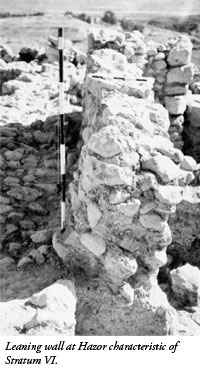
Earthquake evidence is seen prominently at Hazor, Israel's largest ancient city. In excavations beginning in 1955 by archaeologist Yigael Yadin, twenty-two successive cities were discovered to have been built on top of each other.2 Excavations in Hazor's Stratum VI revealed tilted walls, inclined pillars, and collapsed houses. In the Iron Age building called "Ya'el's House" within Stratum VI, objects of daily use were found beneath the fallen ceiling. General southward collapse within Stratum VI argues that the earthquake waves were propagated from the north. After more than 50 years of excavations at Hazor, earthquake damage continues to be revealed in even some of the strongest architecture.
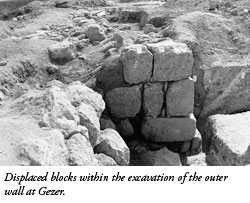
The city of Gezer was also severely shaken. The outer wall of the city shows hewn stones weighing tons that have been cracked and displaced several inches off their foundation. The lower part of the wall was displaced outward (away from the city), whereas the upper part of the wall fell inward (toward the city) still lying course-on-course.3 This indicates that the wall collapsed suddenly.
A Magnitude 8 Event
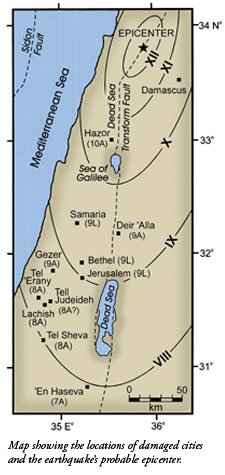
Earthquake debris at six sites (Hazor, Deir 'Alla, Gezer, Lachish, Tell Judeideh, and 'En Haseva) is tightly confined stratigraphically to the middle of the eighth century B.C., with dating errors of ~30 years.4 So, the evidence points to a single large regional earthquake that occurred about 750 B.C. The accompanying map displays the site intensity (Modified Mercalli Intensity from archaeology or literature) and lines of equal intensity of shaking (isoseismals).
The epicenter was clearly north of present-day Israel, as indicated by the southward decrease in degree of damage at archaeological sites in Israel and Jordan. The epicenter was likely in Lebanon on the plate boundary called the Dead Sea transform fault. A large area of the ancient kingdoms of Israel and Judah was shaken to inflict "general damage" to well-built structures (what is called Modified Mercalli Intensity 9 or higher). The distance from the epicenter (north of Israel) to the region of "significant damage" to well-built structures (what is called Modified Mercalli Intensity 8 that is south of Israel) was at least 175 kilometers, but could have been as much as 300 kilometers.
Using the pattern and the intensity of damage through the region of the earthquake, the earthquake's magnitude can be estimated. Through a process known as scaling, the damage areas of smaller historic earthquakes of known magnitude are used to scale upward to estimate the area of damage and magnitude of the regional earthquake. Based on this method, the earthquake in question was at least magnitude 7.8, but more likely was 8.2.5 This magnitude 8 event of 750 B.C. appears to be the largest yet documented on the Dead Sea transform fault zone during the last four millennia. The Dead Sea transform fault likely ruptured along more than 400 kilometers as the ground shook violently for over 90 seconds! The urban panic created by this earthquake would have been legendary.
Scriptural References
In the mid-eighth century B.C., a shepherd-farmer named Amos of Tekoa de livered an ex tra ordinary speech at the Temple of the Golden Calf in the city of Bethel in the northern kingdom of Israel just "two years before the earthquake" (Amos 1:1). Uzziah was king of Judah and Jeroboam II was king of Israel. Amos spoke of the land being shaken (8:8), houses being smashed (6:11), altars being cracked (3:14), and even the Temple at Bethel being struck and collapsing (9:1). The prophet's repeated contemporary references to the earthquake's effects is why it bears his name.
Amos' Earthquake impacted Hebrew literature immensely.6 After the gigantic earthquake, no Hebrew prophet could predict a divine visitation in judgment without alluding to an earthquake. Just a few years after the earthquake, Isaiah wrote about the "Day of the Lord" when everything lofty and exalted will be abased at the time when the Lord "ariseth to shake terribly the earth" (Isaiah 2:19, 21). Then, Isaiah saw the Lord in a temple shaken by an earthquake (Isaiah 6:4).
Joel repeats the motto of Amos: "The Lord also will roar out of Zion, and utter his voice from Jerusalem," and adds the seismic theophany imagery "the heavens and the earth shall shake" (Joel 3:16; compare Amos 1:2). After describing a future earthquake and panic during the "Day of the Lord" at Messiah's coming to the Mount of Olives, Zechariah says, "Yea, ye shall flee, like as ye fled from before the earthquake in the days of Uzziah king of Judah" (Zechariah 14:5). The panic caused by Amos' Earthquake must have been the topic of legend in Jerusalem, because Zechariah asked his readers to recall that terrifying event 230 years later.
The author of Hebrews asks us to keep in mind the coming cosmic shakedown that will finally usher in the future "kingdom which cannot be moved" (Hebrews 12:28). In light of God's marvelous promises to those who believe, "let us have grace, whereby we may serve God acceptably with reverence and godly fear."
References
  1. Austin, S.A., G. W. Franz, and E. G. Frost. 2000. Amos's Earthquake: An extraordinary Middle East seismic event of 750 B.C. International Geology Review. 42 (7): 657-671.
  2. Yadin, Y. 1975. Hazor, the rediscovery of a great citadel of the Bible. New York: Random House, 280 pp.
  3. Younker, R. 1991. A preliminary report of the 1990 season at Tel Gezer, excavations of the "Outer Wall" and the "Solomonic" Gateway (July 2 to August 10, 1990). Andrews University Seminary Studies. 29: 19-60.
  4. Austin et al, Amos's Earthquake.
  5. Austin et al, Amos's Earthquake.
  6. Ogden, K. 1992. The earthquake motif in the book of Amos. In Schunck, K., and M. Augustin, eds., Goldene apfel in silbernen schalen. Frankfurt am Main: Peter Lang, 69-80; Freedman, D.N., and A. Welch. 1994. Amos's earthquake and Israelite prophecy. In Coogan, M.D., J. C. Exum, and L. E. Stager, eds., Scripture and other artifacts: essays on the Bible, and archaeology in honor of Philip J. King. Louisville, KY: Westminster John Knox, 188-198.
* Dr. Austin is Senior Research Scientist and Chair of the Geology Department.
Cite this article: Austin, S. 2010. The Scientific and Scriptural Impact of Amos' Earthquake. Acts & Facts. 39 (2): 8-9.
 
 
....

Taken from: http://www.icr.org/article/scientific-scriptural-impact-amos-earthquake/

Monday, July 1, 2013

Prophet Amos or a Jonah?


So You See Yourself as a Prophet? An Amos or a Jonah?
by Vernard Eller


This work may be freely reproduced and distributed provided that that no changes are made, no revenues are collected beyond the nominal cost of media, and credit is given to the author. Any other use requires the written permission of the author. Citing this material on other Internet sites is encouraged, but is to be done only by providing a hypertext reference to this file on this server.
Bible selections are from the New Revised Standard Version of the Bible, copyright 1989 (NRSV) by the Division of Christian Education of the National Council of the Churches of Christ in the USA. Used by permission. All rights reserved.
With some regularity today's social activists of the Christian Left appeal to the Old Testament prophets as precedent for their confrontational protest-witness against the powers. I here want to suggest that we will be in better position to evaluate that claim if we first decide whether, by "Old Testament prophet," we mean Amos or Jonah. There's a difference.
To launch the inquiry I now offer parallel, diagrammed sentences characterizing the work and message of Amos and of Jonah (conveniently ignoring Obadiah, whose book accidentally is sandwiched between the two we want to compare):

AMOS JONAH
1 THE HOLY GOD The Tandem of HOLY GOD and HOLY-JEW JONAH
2 acts in weeping judgment acts in dry-eyed condemnation of
3 UNHOLY HUMANITY UNHOLY NINEVITES
4 to bring it to his Wine Festival to bring them to Destruction

Amos (1)

Both Amos and Jonah betray a certain reticence regarding their callings--though the significance is entirely different in the two cases. First, regarding Amos, notice that he is not so much as named in the sentence-diagram pertaining to him. That is at his own request:
I am no prophet, nor a prophet's son; (Amos 7:14a)
"It would be wrong to name me along with the Holy God--as though I were somehow his colleague, confidant, or representative."
but I am a herdsman, and a dresser of sycamore trees,, and the LORD took me from following the flock, and the LORD said to me, "Go, prophesy to my people Israel." (Amos 7:14b-15)
"If you insist on naming me in your sentence, it should be down at No. 3, under 'Unholy Humanity.' God did commandeer my mouth--but I deserve no credit for that nor does it in any way affect my status. It clearly was not the case that he chose me because I was a 'prophet,' a holy man, an authority on holiness, or anything of the sort. I certainly hope you haven't been hearing me as thought I think I have the right and capability of making moral judgments on peoples, kings, and nations--showing them where they are wrong and telling them what they will have to do to get right in my eyes. I'm no prophet--nor even as much as a son of one."

Jonah (1)

Jonah, on the other hand, sees no problem at all in being identified with the Lord God of Israel. In fact, particularly in the face of no-good pagans, he is positively eager to so identify himself (whether God agrees or not):
I am a Hebrew .... I worship the LORD, the God of heaven, who made the sea and the dry land. (Jon. 1:9)
Well, yes, he was stretching it a bit as to how much he worships the Lord; yet it doesn't hurt to strike a little fear into dumb pagans by letting them know with just whom they are dealing. And thus Jonah's reticence regarding his prophetic calling comes at a quite different point from Amos'. Jonah had a premonition (correct, as it proved) that the Lord might not let him be as big, tough, and damning a prophet as he had in mind for himself to be.
"What kind of a God of 'holy justice' do you think you are? --Going soft on these Ninevite devils just when we were set to really lay it in 'em."
Is not this what I said while I was still in my own country? That is why I fled to Tarshish at the beginning; for I knew that you are a gracious God and merciful, slow to anger and abounding in steadfast love, and ready to relent from punishing. (Jon. 4:2)
"And for that matter, just what kind of a 'prophet' do you think this leaves me looking like? Nothing doing. Either the word is 'Yet forty days and poof (and really mean it)--or else I quit."
Where, in the Amos sentence, appears the word "judgment," in the Jonah sentence is the word "condemnation." They are in no wise the same. When the Judge involved is the LORD, then "judgment" is but the necessary first word--the word of diagnosis as to precisely what is the sin-illness at the root of the difficulty, and this word comes first just so the next step of that "judgment" might be whatever redemptive punishment is called for in getting the problem corrected. However, completely to the contrary, "condemnation" is always a last word, after which there is nothing more to be said. Amos speaks judgment--gracious judgment.

Amos (3)

With No. 3, things fall into a true and properly theological alignment. God alone--the one true HOLY--is in the top spot; and all humans and everything that is human (Jews and Gentiles, prophets (including Amos himself), priest, and king) everything here falls equally under God's ultimately-gracious judgment.

Jonah (3)

However, the counterpart Jonah-alignment is not theological at all but is sheerly intra-human partisan politics. Although posing as a zeal for God, the business shows not a hint of the true God's ("gracious, merciful, slow to anger, abounding in steadfast love, and repenting of evil") actual involvement. No, the only "holy" is Jonah's holy Jewish self-righteousness and "God" but a name Jonah uses to justify his human-Jewish holy hatred of Ninevites. Under the guise of a "prophet of God," one sinful worldly (leftist) party that deems itself "holy" takes the opportunity to vent its spleen against another sinful worldly (rightist) party it has deemed "demonic." There is nothing of God in it--just political ideologies.

Amos (4)

With Amos, it turns out that--even through all the painful threat and punishment--God's actual purpose was to get people to his Wild and Wonderful Wine Festival:
The time is surely coming, says the LORD, when the one who plows shall overtake the one who reaps, and the treader of grapes the one who sows the seed;
the mountains shall drip sweet wine, and all the hills shall flow with it. (Amos 9:13)
Anyone who undertakes to drop a grape seed had better be prepared to leap smartly to one side to avoid having his heels clipped by the cluster-clippers coming closely behind. (Even if God's word is inerrant, I can't help but feel that Amos is exaggerating a bit.) The hills will be loaded with liquor--and the plains inevitably inundated. (I, too, feel the problem that comes with this scripture and so have initiated inquiries as to whether Amos might not permit the insertion of a not to the effect that non-alcoholic beverages will be available for pious prudes like myself.)

Jonah (4)

The very opposite of Amos, with Jonah we wind up with nothing but "grapes of wrath"--and these, too, growing fast and all over the place.
"Jonah," it is the Lord God who speaks, "you are an abomination and object of wrath to me. You are a 'prophet of God' who proclaims your own false Jingoistic Jewish Justice in place of my true justice. Because it offends your own perverted sense of righteousness, you flatly refuse to mention or to represent the grace and mercy of my righteousness. And now here you are bawling your eyes out over the loss of a dumb plant whose shade you valued--while trying to deny me the right to bewail the loss of a whole big cityful of my Ninevite children. I damn you, Jonah: if you can't bring yourself to regard Ninevites, can't you at least shed one little tear fro all those poor Ninevite cows? Amos has the grace to say he is not a prophet, yet is as true a one as they come. You have the gall to call yourself a prophet, but are as far from being one as can be."
I leave it to the readers to judge to what extent this analysis applies to those confrontational activists of the Christian Left who presently clam the status of Old Testament prophets. I will observe only that, in the tradition, being "a prophet of God" certainly is nothing a representative of the tradition takes any joy in being "speaker of judgment"; and our most honored examples were either reluctant to take on God's assignment or were on the lookout for opportunities actually to resign it. And conversely, in scripture, those who do seek the post or take satisfaction in it--these regularly turn out to be the Jonahs, Zedekiahs, Hananiahs, and other "politicians" who are in the wrong spot, doing the wrong thing, for the wrong reasons, in the service of the wrong master.

....

Taken from: http://www.hccentral.com/eller1/prophet.html